
According to market research, the global apparel market is valued at $1.84 trillion in 2025, accounting for 1.63% of the world’s GDP. India is no less than behind. The revenue in the apparel market in India is projected to reach US$109.45 billion in 2025 and is anticipated to remain a high-growth market, potentially experiencing a 10-12% CAGR from 2024 to 2030.
Although it is one of the rapidly growing industries in India, it faces numerous issues. Apart from seasonality and fluctuating global demand, operating costs, and issues such as a lack of management and lower data security, productivity is also affected. If you own an apparel manufacturing unit and are facing similar issues, an enterprise resource planning or ERP for garments manufacturing can solve all these issues.
Before exploring the solution, it is essential to identify the underlying issues first. As an owner, it helps you to get an overview of the real-time problems.
Apparel manufacturing is an integrated process. Every unit of the company must work together to meet deadlines and achieve the production standard. It includes departments such as fabric store, sampling, spreading and cutting, sewing, quality assurance, finishing and packaging, finance, and others.
Supply chain disruption is one of the most common issues for apparel manufacturing units. Global supply chains face issues such as shipment delays and shortages of raw materials due to weather or other factors.
Even after contributing a significant amount to the GDP (gross domestic product), the security of these units is often overlooked. Purchase orders, sales orders, manufacturing orders, fact sheets, industry-specific brochures, HR files, and employee data sheets are some of the documents that are often overlooked. It mainly occurs due to a lack of management and property security channels.
Read more about Common Issues Faced By Garment Manufacturers
Inventory management is one of the most crucial tasks of garment manufacturing. You must comply with the trends. A single missing algorithm can not only result in monetary loss but also lower the brand’s visibility. However, due to incorrect market forecasting and a lack of trend tracking, companies often face faulty inventory management and substantial losses. Additionally, running out of stock when demand is high can harm customer satisfaction and lead to permanent business loss.
Although quality is essential for every industry, it is particularly paramount in the garment and fashion sector. Issues with inconsistent sizes and material problems can negatively impact the brand image and erode user trust.
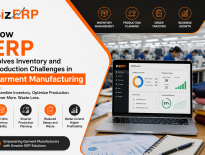
Only an updated technology, such as ERP for garments manufacturing, can effectively handle a rapidly growing industry like the garment sector. The latest software integrates all departments, including inventory, production, and finance, seamlessly and reduces the likelihood of errors. This effective integration also helps increase operational flow and contributes to fulfilling market demands.
From design to fabric sourcing, production and distribution, apparel manufacturing involves various steps. An ERP for the garment industry efficiently integrates all departments on a single platform, reducing the number of errors and paperwork. This not only enhances communication between teams but also improves the quality of production by reducing manual errors.
As stated, market trends and demands change rapidly, and your inventory must be ready to meet all the shifts in consumer preferences. An ERP solution tracks the storage and informs you about its availability. Additionally, it tracks reorders and provides valuable market forecasting, enabling you to stay prepared for potential market changes.
The garment industry is volatile; even a small miscalculation can result in substantial losses. The ERP software helps in accurately comparing and tracking material and labour costs. The latest technology also offers detailed reports on profit margins and cost centres. This enables you to review your expenses and develop a more effective pricing strategy.
Also Read: Ultimate Guide to Deal with the ERP for the Garment Industry
An ERP solution is designed to track and ensure the quality of outputs. For this, the software evaluates each step of the production, sets benchmarks for the products, and records the results. It also informs in the event of any issues found and helps with faster corrections.
The garment and fashion industry largely depends on customer satisfaction, and an ERP solution helps you achieve it. For this, the software responds to every query or issue raised by customers and offers unique solutions. Moreover, ERP provides tailored services by analysing their past purchasing behaviour and other traits. It helps in building a personal relationship with each client and strengthening the overall bond.
One of the primary objectives of ERP is to facilitate data-driven decision-making. The software collects business data from various sources and presents it for analysis and review. This includes the names of best-selling products, lower-demand products, seasonal trends and demands, and metrics for different teams and regions. This deeper data helps inform the right actions and increase profitability.
The garment industry is one of the most contentious industries in terms of carbon emissions and water. Hence, integrating sustainable practices is no longer an option; it is the need of the hour, and ERP helps with it significantly. It tracks the carbon footprint, monitors energy consumption, and assesses waste amounts and recycling practices. To combat these issues, the software also helps in sourcing eco-friendly raw materials and trustworthy supply chains.
The garment industry faces numerous challenges that necessitate customised solutions. The ERP for garment industry helps simplify operations and offers real-time data. The real-time data empowers you to take targeted measures to enhance operational efficiency and address internal issues. The latest technology also helps improve overall quality and increase profitability. Therefore, it is high time to integrate an ERP solution in your apparel manufacturing unit.
Are you seeking a trustworthy vendor to provide ERP for garments manufacturing? Contact us. At BizERP, we offer ERP solutions specifically designed for the apparel industry. Our cloud-based end-to-end solution takes care of every department of your company and elevates the entire process.
Contact us for an ERP solution now.