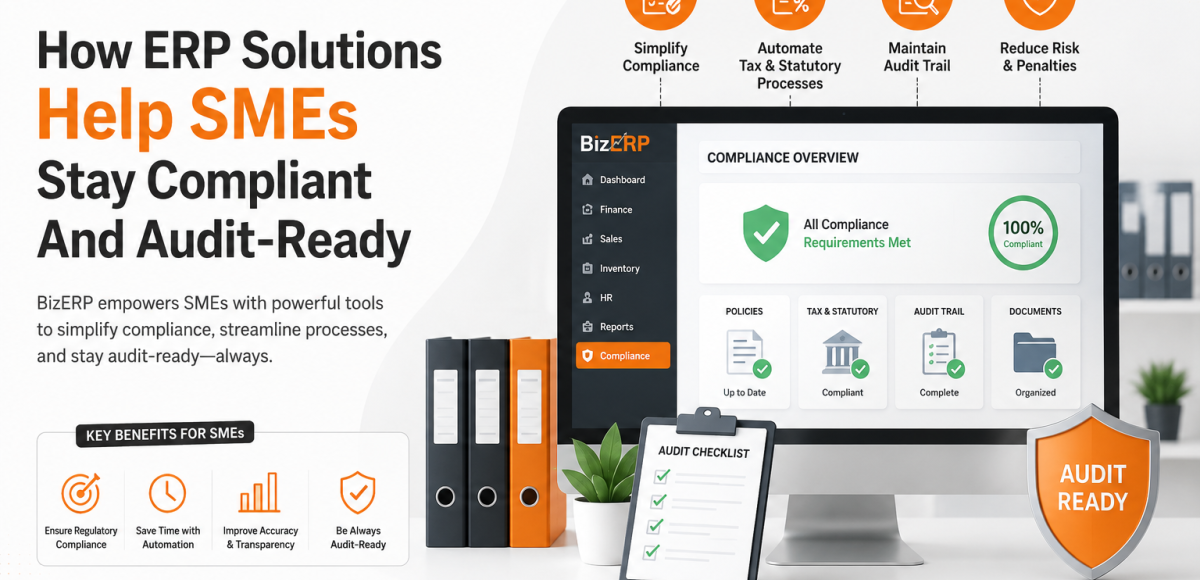
Running a small or medium-sized business comes with a long list of responsibilities, and staying compliant is one of the important ones. Tax deadlines, financial reporting, data regulations, and following industry standards; there’s a lot to worry about. For many business owners, keeping on top of all this while running the business can feel a little too daunting. Luckily, there’s a smarter way to handle it all.
Using an ERP solution for SMEs allows businesses to bring everything under one roof. It makes compliance feel less of a scramble and more of a natural by-product of how the business operates on a daily basis.
Compliance wasn’t designed with small businesses in mind. However, the rules and regulations that govern financial reporting, payroll, VAT submissions, and data handling stay the same whether you have a 10-person team or a 1000-person corporation. The only difference is that large enterprises have entire departments dedicated to managing it.
This is often the reason why small businesses miss deadlines. Records become inconsistent. Their data lives in multiple places. Think of a spreadsheet here, an email there, or somewhere in a folder that no one has checked in a really long time. So, when an audit comes calling, that scattered approach becomes a very expensive problem.
One of the important things that an ERP solution for SMEs does is bring all your business data into a single, organised place. This includes sales records, purchase orders, payroll information, and financial transactions. All of this sits in one system, updated in real time, and accessible by the right people.
Instead of frantically looking through folders and cross-referencing spreadsheets, everything an auditor needs is already there. This kind of transparency makes audits less stressful and also shows that the business operates with complete control/ integrity.
Tax compliance is one of those aspects where SMEs genuinely struggle from time to time. VAT returns, corporation tax, and payroll submissions have their own rules, deadlines, and consequences if things go wrong.
This is where a well-maintained ERP solution for SMEs shines. It handles much of this automatically. It tracks transactions in real time, applies the correct tax codes, and generates accurate reports. They thus make submissions straightforward.
That said, regulatory requirements beyond tax, such as data protection, are also easier to manage when your data is centralised, and access is properly controlled.
Being audit-ready means operating in a way where, if an audit happened, you’d be completely prepared. That readiness comes from clean records, consistent processes, and clear visibility across the business. It means having an unbroken trail of every transaction, every approval, and every change. For businesses using ERP systems, it’s simply how things work.
This confidence comes from knowing your records are accurate, and every process is well-documented: not only for the audit but also for everyday decision-making.
Compliance and audit-readiness aren’t the most exciting parts of running a business, but they are important nonetheless. At BIZ ERP, we know that no two businesses are the same, which is why we’ve built ERP solutions tailored to a wide range of industries. We help small and medium enterprises take real control of their operations by centralising everything. In short, we bring enterprise-level organisation to businesses of every size. Contact now.