
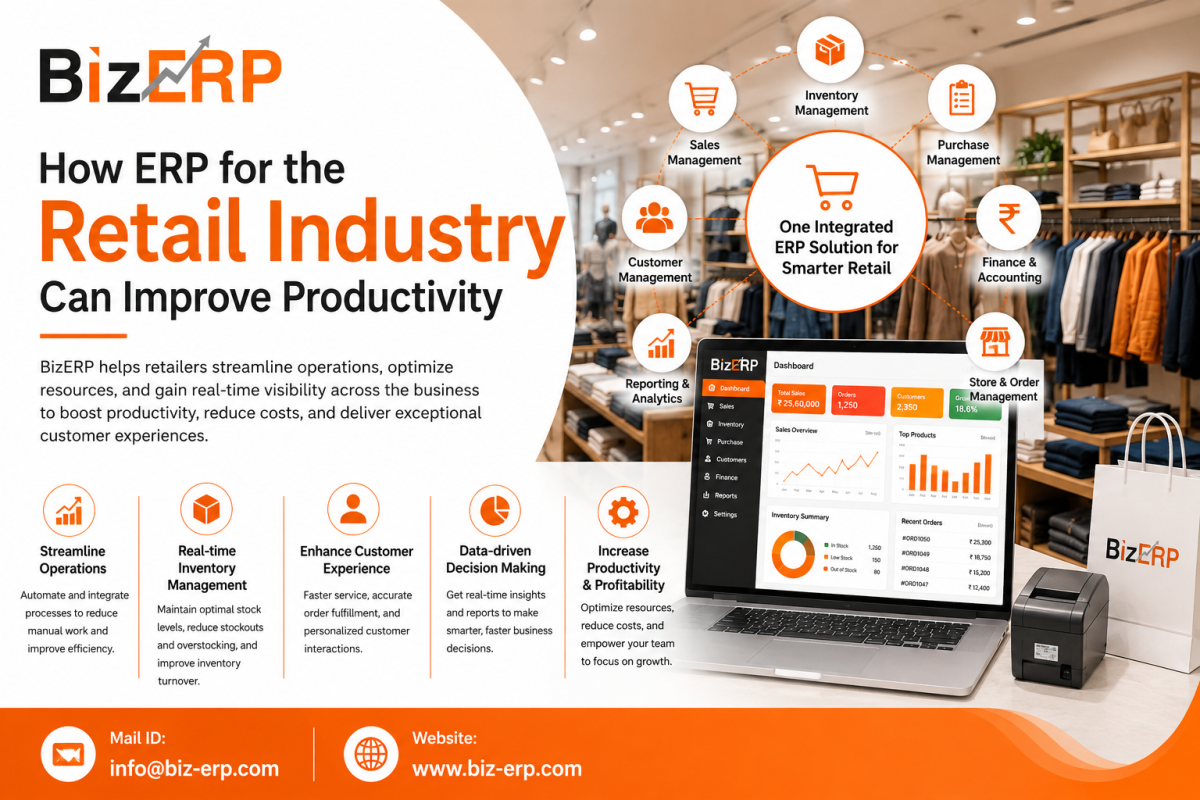
Retail may seem one of the most dynamic sectors at the moment, as it involves meeting customer expectations. Here, you may notice high competition. Most businesses still rely on standalone systems, which may lead to inaccurate data and inconsistent reporting. Due to this reason, it may be quite natural to observe workflow disruptions. An ERP for the retail industry may help address these issues. It can be a single source that helps you manage inventory and forecast sales. Thanks to the system, productivity gains are observed.
Key Ways ERP Software Boosts Performance
Streamlined Billing Processes and Point-of-Sale
For both the employees and customers, the point-of-sale system is a critical touchpoint. A robust ERP system can integrate the POS directly with the accounting, inventory, and CRM modules. Every sale may reflect on stock levels. It becomes possible to update the financial ledgers while contributing to the customer data profile. It may help avoid the need for manual syncing or periodic data transfer.
Properly Aligned Workforce and Store-Level Performance
When it comes to retail efficiency, neither employee scheduling nor productivity is typically considered a primary driver. It is one of the places where you may be making a major mistake. ERP can be connected to staff attendance and rosters to analyse store-level outcomes.
Retailers can employ staff based on sales and footfall rather than on a uniform schedule. It may help ensure better utilisation of labour. Overtime costs can be reduced to some extent by aligning with customers’ real demand.
Financial Tracking Across Channels for Compliance
Retailers may operate across multiple channels, including online and offline marketplaces. In addition, there may be direct-to-customers platforms. If you have a unified financial view, assessing margins and consolidating reports may not be difficult. Budget planning can be effective.
ERP provides real-time financial visibility by integrating payout and billing systems. It enables tracking profitability across locations and product lines. Insight can help achieve effective forecasting and timely corrections.
Guaranteed Smarter Procurement
Issues such as overstocking and shockouts can be avoided by addressing poor demand visibility. ERP systems keep records of historical sales, external variables, and supplier lead times. It is also possible to forecast demand at the SKU level.
Procurement and Supplier Coordination
Most retailers and suppliers can ensure timely delivery using ERP software. Simplifying procurement is possible through a detailed review of order history, supplier performance history, and delivery timelines. By using the automated purchase orders, status updates and approvals, you can easily avoid delays. It can also help improve customer relationships.
Thanks to access to historical data, the procurement team can work more effectively and maintain supply chain consistency. It may also help reduce the administrative burden.
For a high-quality ERP for the retail industry, you can get in touch with the experts from Biz ERP. We can ensure the best service for your online store. Call or contact us today to know more about our services.
