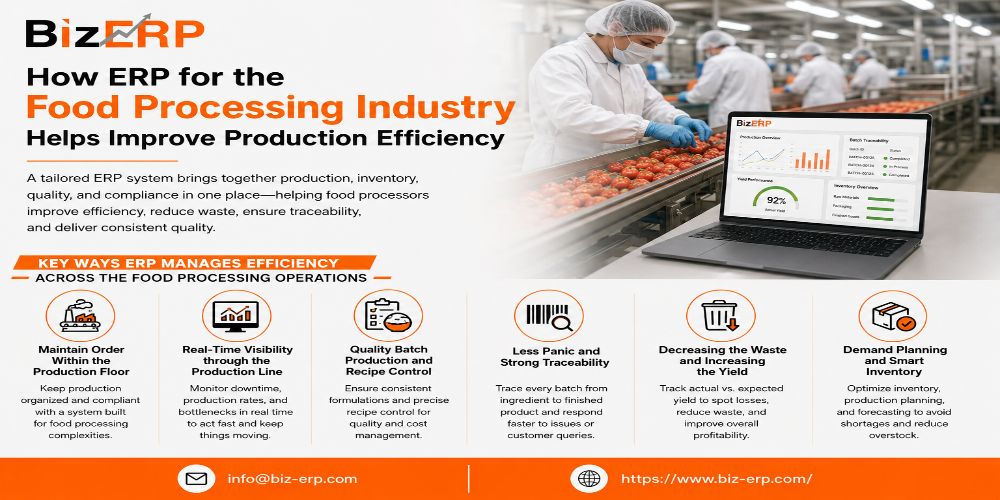
The food manufacturing industry is evolving continuously. In recent years, several changes have been made to the regulations. Experts are placing a great deal of importance on food safety. By using advanced technology, it is possible to minimise disruptions in the food supply chain while maintaining consumer satisfaction. The use of ERP in the food processing industry is one reason manufacturers can adopt modern technologies to deliver higher-quality products.
Future-Proofing Food Businesses with Smart ERP Solutions
Complying with the Regulations: Maintaining Traceability
Expectations of consumers and governments are increasing regarding the food industry’s standards for traceability. It has become essential for a good reason. Bidirectional tracking can play a crucial role in maintaining food safety levels. It may help to track the sources of contamination.
When utilising an ERP for the food processing industry in Kolkata, it is possible to obtain customised traceability tools. It helps streamline everything while meeting regulatory standards. Real-time updates will be available through the barcode scanners. It may help manufacturers act promptly, depending on the availability of data.
Deploying Cloud for Optimum Flexibility
For a food and beverage manufacturer, maintaining a smooth supply chain can be a constant challenge. Due to material shortages, increased transportation costs, and fluctuating demand, the supply chain may become disrupted. When faced with these issues, it becomes essential to become flexible.
If a food processing ERP is implemented with a cloud platform, employees can access information about stock at any time. They need to have a WiFi connection and a web browser. The use of the advanced system may help avoid interruptions during food production at the bay.
Cloud-based ERP assures operational efficiency by providing data in a seamless and synchronised manner. It can make the procurement process, in addition to manufacturing and supply, much easier. It may enable faster data sharing across different departments and teams. When most employees have access to real-time data, they can facilitate a more effective collaborative effort. Informed decision-making will be possible after facing a challenge effectively and collectively.
If a manufacturer utilizes a cloud-based ERP software for the food processing industry, there will be no need to undergo a manual upgrade process. It also reduces the downtime while keeping the operations smooth. Stakeholders can get access to the information, eliminating confusion from the process. While using the cloud-based system, outdated software may not hinder business operations.
Enabling Production Innovation Through Formula Management
Based on the modern tastes of consumers, businesses can start producing functional foods, plant-based products, and offering organic ingredients. It can make the business more relevant, appealing, and profitable. Gen Z customers are extremely health-conscious. Since they control a growing portion of the market, it has become necessary to give them considerable importance. On occasion, it is necessary to utilize the best tools for designing and creating innovative products that cater to customer preferences and trends.
By utilizing the recipe and formula management feature of the best ERP system for food processing, manufacturers can research and develop innovative products. A recipe management system may help to safeguard the formula. It becomes possible to keep the recipe secure by giving a limited number of employees access to the information. It is a standardized process that helps deliver quality products batch after batch without fail. It becomes possible to maintain the ingredient ratio while meeting regulatory requirements.
When dealing with a new supplier or securing materials, the comprehensive inventory control feature of the ERP system can help keep everything on track. A food manufacturing company can elevate the process of formula management and product innovation to new levels. Every stage of the food development can stay streamlined.
Scaling Up for Growth
The product development process appears costly and takes months to yield the desired results, especially when a wide range of platforms are utilised. Therefore, it becomes essential to find a system that can streamline everything according to current needs. ERP for the food industry can come to your rescue on occasion. It allows for scaling up and down depending on the market demand and the company’s growth.
Food manufacturing ERPs are designed to optimise operations with ease. It allows the creation of new lines, departments, and roles. The configuration of the system backend happens based on the knowledge acquired. Two businesses may not face the same issue. Therefore, experts can customise the system. Technology usually adapts itself to take care of the foreseeable future.
A cloud-based ERP system can increase the possibility of scaling operations with unmatched flexibility. Thanks to the increased data storage and accessibility features, it has become possible to support the growth. Since updates happen automatically, manufacturers can get an up-to-date system. There may not be any disruption on the way at all.
Experts recommend using a modular approach for the software implementation, as it can empower the manufacturer. When an ERP system for the food industry is used in conjunction with other complementary software systems, it can reduce the upfront cost. Decreased implementation time can aid in the scaling of a business. Digital transformation with the ERP system can unlock more benefits in the future.
Managing the Supplier for the Supply Chain Resilience
For every food manufacturing industry, suppliers act as the backbone. Therefore, an effective management system is necessary for ensuring a resilient supply chain. It ensures that you have the product whenever you need it. With the ERP for food processing industry, it is possible to access a supplier portal for tracking, communicating, and monitoring quality. A centralized data system may help gain a deeper insight into customers. On occasion, consistency of the delivery can be maintained.
Biz ERP offers comprehensive ERP software for the food processing industry. Specialized software with cloud implementation can help manufacturers stay ahead of their competition. We ensure that the manufacturer enjoys smooth operations. Whenever a manufacturer requires the software, we will be there to help them. Contact us to know more.