
Categories
Blog

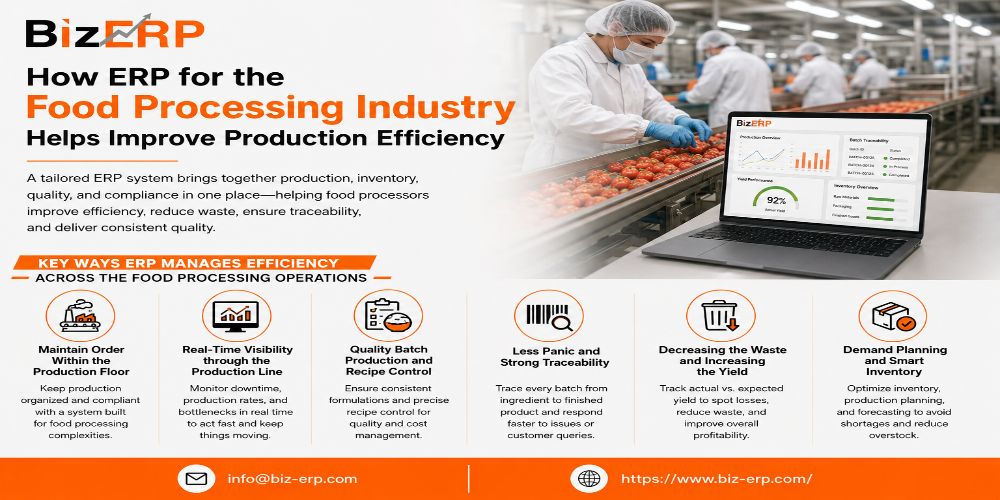
How ERP for the Food Processing Industry Helps Improve Production Efficiency

If batch records are scattered across spreadsheets or supervisors are constantly chasing you for yield figures, it creates a lot of stress. Maintaining compliance, quality, and output becomes difficult. Things can fall through the cracks instead of working together to deliver the desired result. This is exactly when you need an ERP for the food processing industry. It usually helps keep inventory, production, and compliance in check. It becomes possible to keep everything in one place.

Key Ways ERP Manages Efficiency Across the Food Processing Operations

Maintain Order Within the Production Floor

Food manufacturing comes with many quirks. Strict traceability rules, perishability, and fluctuations in raw material quality create many issues. A generic ERP can’t handle these challenges. A system built specifically for the food processing industry can take the pressure off your shoulders. Instead of your operation, the software is customised to deal with any situation effectively.

Real-Time Visibility through the Production Line

One benefit of an ERP system is knowing exactly what’s happening on the production line. Instead of end-of-shift reports, supervisors can quickly see downtime, production rates, and potential bottlenecks as they happen. Small issues can be caught and corrected quickly. This makes it easier to avoid serious issues.

Quality Batch Production and Recipe Control

Formulation consistency is essential in food production. This helps manage cost and quality at the same time. A good ERP system tracks formulations and applications properly. Your production line stays under control. Every bit of information is recorded instead of staying only in someone’s mind.

Less Panic and Strong Traceability

If traceability is maintained from the ingredient stage to the completion stage, you do not have to guess anything. By tracingBy tracing a batch back, you can quickly identify when an issue arises with a supplier lot. In case the customer needs the information, data transfer can happen within minutes. 

Decreasing the Waste and Increasing the Yield

Most food is perishable in nature. For this reason, it directly impacts the business’s profitability. An ERP system can track actual yield against expected yield for every batch. It shows where your losses are creeping up. Here, the issue can be over-portioning, inefficient changeover between product lines, and spoilage.

Demand Planning and Smart Inventory

Shortages of key ingredients or over-ordering ingredients with a shorter shelf life can lead to costly mistakes. An integrated inventory system, one of the most effective ERP features, makes it possible to understand stock levels. Understanding available stock helps create a better production schedule and a sales forecast.

Whenever you need an ERP for the food processing industry, you can get in touch with the experts from BizERP. 

Categories
Blog

3 Ways EPC Companies Can Benefit With ERP Software

If you want to manage various business functions using the same platform, it’s time you start looking for a reputable company developing ERP software for EPC companies. The objective is to get operational efficiency and better transparency. Not only will the software help you manage the issues on your premises but even your employees can connect remotely using VPNs. Numerous remote workers can stay connected, which is a blessing in disguise for EPC companies. They can keep themselves updated about job costs, project documents, budgets, contracts and payroll. They can use their mobile devices to enter data and sync the information to the cloud system.

Few Benefits Of ERP For EPC Companies

Manage Project Schedule

Two vital aspects of every EPC project are project planning and scheduling. EPC organisations can lose clientele and money in the form of labour costs if they fail to complete their targets on time due to inefficient planning. Project planning and management will become easier with the right ERP Software. Managers will have more control over the project to efficiently plan the tasks and follow them. They can even track the project’s status, delegate assignments and create milestones.

Estimate Revenue

EPC companies have to follow legally binding contractual agreements when providing services. Generally, they start bidding for a tender after providing an estimated cost of the project. The customer considers the firm’s reputation, the proposed quotes and the proposed design before choosing the most suitable bid. ERP for EPC companies is specially designed to make it easier for them to provide accurate quotes for raw materials, design and human resources. They can even use it to calculate accurate revenue.

Inventory And Materials

Managing inventory and materials is a complicated and time-consuming task for EPC companies. They can ease the procurement of materials, planning and storing, real-time inventory tracking and timely disposal with customised ERP software. Using one almost becomes necessary when working on multiple projects. How the materials and inventory are managed determines the profitability of an EPC company.

Since ERP software can benefit EPC companies in so many ways, it’s time you get in touch with the experts at LNSEL for Biz ERP.

Categories
Blog

Top 4 Mistakes to Avoid While Selecting an ERP Software for Food Processing Industry

Enterprise Resource Planning software is a core requirement for modern-day businesses. It comes with a single integrated database that helps streamline operations. Productivity increases with greater efficiency and output. However, people commit a few common mistakes while implementing the ERP for food processing industry. In this blog, we will discuss them in detail. It is necessary to find the best solution suited to the business.   

Mistakes to Avoid During  Implementation of ERP for Food Processing Industry

1. Only look at big names.  

Most organizations start ERP selection with a list of the biggest companies. They go with reputable names in the ERP market. Big-name vendors are indeed reliable, but they might charge extravagant prices for it. Often their products might not be a good fit for your medium scale business. You should not determine ERP selection by considering the business name; rather, the quality should matter. With small vendors, you can opt for customization and frequent changes without hassle.     

2. Thinking All ERP Solutions Are Same

This is not true at all. Businesses often mistake the ERP software as a one-kind-fit-all system. It works differently for different businesses. Each ERP software comes with various modules as per the company need. The features and benefits also differ. At first glance, it might seem like the two solutions are exact. However, they vary considerably. Moreover, each ERP software is designed to meet the requirement of a particular company. It cannot work for other types of business workflow.  

3. Keeping an undefined scope  

A large part of the ERP selection process is to look across the organization’s depth. You should try to understand better the workflow and processes that can be automated with the software. You should assess the areas for improvement and the exact business needs. The ERP selection process should begin after you have cleared all these aspects. This way, you avoid potential mistakes and repetitions. It is advisable to talk to the internal team members to analyze their needs. On the other hand, ERP vendors will be eager to sell you the software, but you should not rush. It is critical to know your needs before finalizing the ERP software implementation.  

4. Budgeting  

Most businesses do not decide on a budget while selecting the ERP software. Also, the estimated price might need to depict the total ownership cost. There are additional costs linked to it too, such as –  

  • There may be the case for custom changes or complex integrations
  • You might need project management on the side 
  • Costs for data migration can cost additional money    
  • The cost associated with a network structure, connectivity and device can also get costly.  

Since you know about the common mistakes people make while selecting the ERP software, you can be careful about the same. This way, you can find suitable software for your business model.