
Categories
Blog

How ERP Solves Inventory and Production Challenges in Garment Manufacturing

The garment manufacturing industry runs on speed, precision, and razor-thin margins. A single missed fabric delivery, an inaccurate stock count, or a delayed production update can throw off an entire order — costing time, money, and customer trust. Yet many apparel manufacturers still rely on spreadsheets, disconnected software, and manual tracking to manage operations that are anything but simple.

This is where a purpose-built ERP system like BizERP changes the game. By unifying inventory, production, and business data into a single platform, ERP eliminates the guesswork and gives manufacturers the visibility they need to stay competitive.

Let’s explore the key challenges garment manufacturers face—and see how ERP for Garments Manufacturing provides effective solutions to each one.

1. Fragmented Inventory Visibility

Garment manufacturing involves tracking dozens of variables at once: fabric rolls, trims, buttons, zippers, dyes, and finished goods — often across multiple sizes, colors, and styles. Without a centralized system, inventory data ends up scattered across spreadsheets, paper logs, and separate software tools.

The result: stockouts on fast-moving fabrics, overstocking of slow movers, and production halts because a small component like thread or interlining wasn’t reordered in time.

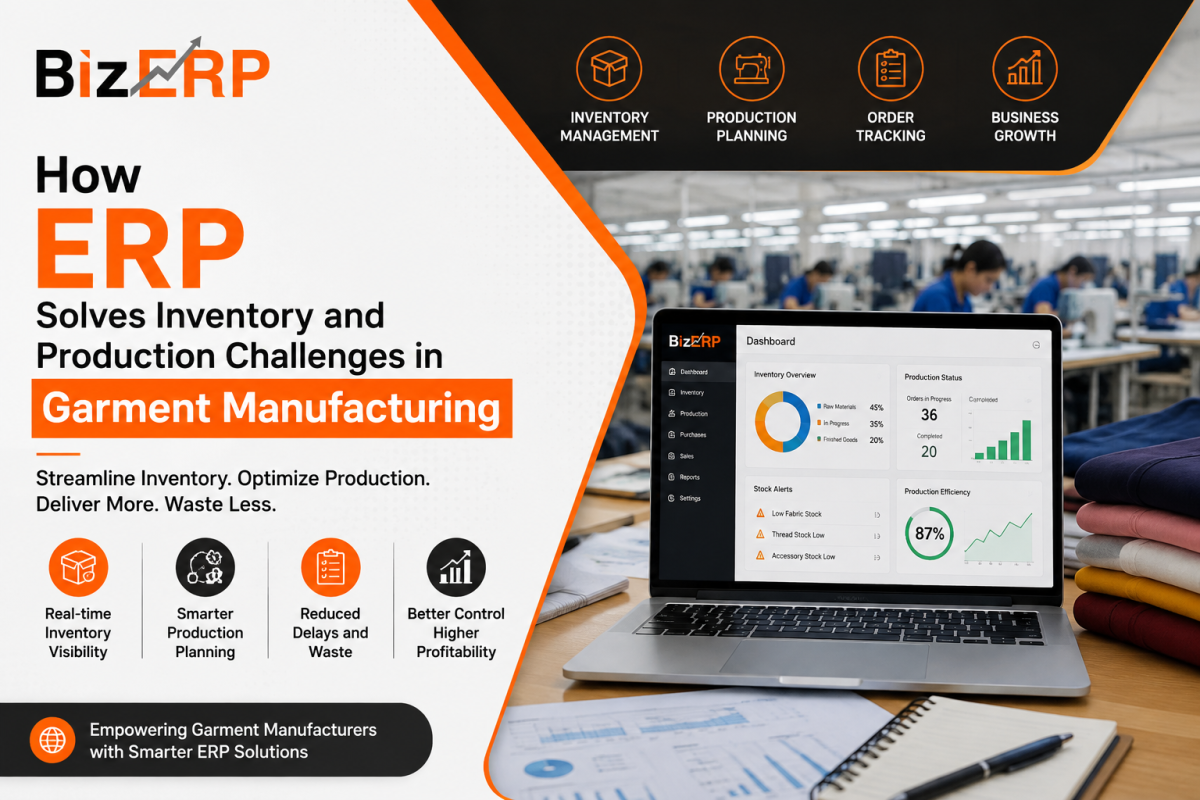
How ERP helps: BizERP consolidates raw material, work-in-progress, and finished goods inventory into one real-time dashboard. Stock levels update automatically as materials move through cutting, stitching, and finishing, so planners always know exactly what’s available — down to the SKU, size, and color.

2. Poor Demand-to-Production Alignment

Garment orders are rarely predictable. Seasonal demand, fashion trends, and bulk B2B orders all create fluctuating production needs. Manufacturers who plan production based on outdated or incomplete data often end up with excess inventory in some styles and shortages in others.

How ERP helps: With integrated sales and production modules, BizERP links incoming orders directly to material requirements planning (MRP). The system automatically calculates how much fabric, trims, and labor are needed based on actual demand — reducing overproduction and minimizing idle inventory.

3. Lack of Real-Time Production Tracking

In a typical garment factory, an order passes through multiple stages: cutting, sewing, embroidery, washing, quality checks, and packing. Without a system to track progress at each stage, floor managers often rely on verbal updates or manual logs — leading to bottlenecks that go unnoticed until it’s too late.

How ERP helps: BizERP provides stage-by-stage production tracking, giving managers a live view of where every order stands. If a batch is stuck at quality control or a stitching line is running behind schedule, the system flags it immediately — allowing quick corrective action instead of last-minute firefighting.

4. Inaccurate Costing and Wastage

Fabric wastage, labor inefficiencies, and untracked rework can quietly eat into profit margins. Many manufacturers calculate costs after the fact, when it’s too late to make adjustments.

How ERP helps: By tracking material consumption against production output in real time, BizERP helps identify wastage patterns early. Automated costing reports break down expenses by order, style, or batch — giving management accurate, up-to-date visibility into true production costs instead of rough estimates.

5. Disconnected Departments and Data Silos

Sales, procurement, production, and finance teams often work off different systems that don’t talk to each other. This causes miscommunication — like sales confirming an order the factory can’t fulfill on time, or procurement ordering materials that don’t match actual production plans.

How ERP helps: BizERP acts as a single source of truth across departments. When a sales order is placed, procurement, production, and inventory teams instantly see the same data, ensuring everyone works from one accurate, synchronized system.

6. Difficulty Scaling Operations

As garment businesses grow — adding new product lines, factories, or export markets — manual processes and outdated tools quickly become a bottleneck. What worked for a small workshop breaks down at scale.

How ERP helps: BizERP is built to scale with the business. Whether managing one unit or multiple factories across locations, the platform maintains consistent processes, centralized reporting, and standardized workflows — so growth doesn’t mean chaos.

The BizERP Advantage

Garment manufacturing doesn’t need generic software patched together with workarounds — it needs a system designed to handle the industry’s complexity from the ground up. BizERP brings together inventory management, production planning, costing, and cross-department visibility into one intuitive platform, helping manufacturers:

  • Reduce material wastage and excess stock
  • Improve on-time order fulfillment
  • Gain real-time visibility across the production floor
  • Make faster, data-driven decisions
  • Scale operations without losing control

Final Thoughts

Inventory and production challenges in garment manufacturing aren’t going away — but they don’t have to hold your business back either. With the right ERP system in place, manufacturers can move from reactive firefighting to proactive, data-driven operations.

BizERP is built to help garment manufacturers take control of their inventory, streamline production, and grow with confidence. If your business is still juggling spreadsheets and disconnected tools, it might be time to see what a unified ERP system can do for you.

Categories
Blog ERP for Garment Industry

Transforming Apparel Manufacturing with ERP Solutions

According to market research, the global apparel market is valued at $1.84 trillion in 2025, accounting for 1.63% of the world’s GDP. India is no less than behind. The revenue in the apparel market in India is projected to reach US$109.45 billion in 2025 and is anticipated to remain a high-growth market, potentially experiencing a 10-12% CAGR from 2024 to 2030.

Although it is one of the rapidly growing industries in India, it faces numerous issues. Apart from seasonality and fluctuating global demand, operating costs, and issues such as a lack of management and lower data security, productivity is also affected. If you own an apparel manufacturing unit and are facing similar issues, an enterprise resource planning or ERP for garments manufacturing can solve all these issues. 

What are the Main Issues Apparel Manufacturing Companies Face? 

Before exploring the solution, it is essential to identify the underlying issues first. As an owner, it helps you to get an overview of the real-time problems. 

Lack of Integration 

Apparel manufacturing is an integrated process. Every unit of the company must work together to meet deadlines and achieve the production standard. It includes departments such as fabric store, sampling, spreading and cutting, sewing, quality assurance, finishing and packaging, finance, and others. 

Supply Chain Inconsistency 

Supply chain disruption is one of the most common issues for apparel manufacturing units. Global supply chains face issues such as shipment delays and shortages of raw materials due to weather or other factors. 

Lower Data Safety 

Even after contributing a significant amount to the GDP (gross domestic product), the security of these units is often overlooked. Purchase orders, sales orders, manufacturing orders, fact sheets, industry-specific brochures, HR files, and employee data sheets are some of the documents that are often overlooked. It mainly occurs due to a lack of management and property security channels. 

Read more about Common Issues Faced By Garment Manufacturers

Faulty Inventory Management 

Inventory management is one of the most crucial tasks of garment manufacturing. You must comply with the trends. A single missing algorithm can not only result in monetary loss but also lower the brand’s visibility. However, due to incorrect market forecasting and a lack of trend tracking, companies often face faulty inventory management and substantial losses. Additionally, running out of stock when demand is high can harm customer satisfaction and lead to permanent business loss. 

Quality Issues 

Although quality is essential for every industry, it is particularly paramount in the garment and fashion sector. Issues with inconsistent sizes and material problems can negatively impact the brand image and erode user trust. 

Benefits of ERP for the Garment Industry

Only an updated technology, such as ERP for garments manufacturing, can effectively handle a rapidly growing industry like the garment sector. The latest software integrates all departments, including inventory, production, and finance, seamlessly and reduces the likelihood of errors. This effective integration also helps increase operational flow and contributes to fulfilling market demands. 

Streamlines the Operations 

From design to fabric sourcing, production and distribution, apparel manufacturing involves various steps. An ERP for the garment industry efficiently integrates all departments on a single platform, reducing the number of errors and paperwork. This not only enhances communication between teams but also improves the quality of production by reducing manual errors. 

Enhanced Inventory Management 

As stated, market trends and demands change rapidly, and your inventory must be ready to meet all the shifts in consumer preferences. An ERP solution tracks the storage and informs you about its availability. Additionally, it tracks reorders and provides valuable market forecasting, enabling you to stay prepared for potential market changes. 

Increased Control Over the Process 

The garment industry is volatile; even a small miscalculation can result in substantial losses. The ERP software helps in accurately comparing and tracking material and labour costs. The latest technology also offers detailed reports on profit margins and cost centres. This enables you to review your expenses and develop a more effective pricing strategy. 

Also Read: Ultimate Guide to Deal with the ERP for the Garment Industry

Quality Assurance 

An ERP solution is designed to track and ensure the quality of outputs. For this, the software evaluates each step of the production, sets benchmarks for the products, and records the results. It also informs in the event of any issues found and helps with faster corrections. 

Increase Customer Satisfaction 

The garment and fashion industry largely depends on customer satisfaction, and an ERP solution helps you achieve it. For this, the software responds to every query or issue raised by customers and offers unique solutions. Moreover, ERP provides tailored services by analysing their past purchasing behaviour and other traits. It helps in building a personal relationship with each client and strengthening the overall bond. 

Data-driven Decision 

One of the primary objectives of ERP is to facilitate data-driven decision-making. The software collects business data from various sources and presents it for analysis and review. This includes the names of best-selling products, lower-demand products, seasonal trends and demands, and metrics for different teams and regions. This deeper data helps inform the right actions and increase profitability. 

Promotes Sustainability 

The garment industry is one of the most contentious industries in terms of carbon emissions and water. Hence, integrating sustainable practices is no longer an option; it is the need of the hour, and ERP helps with it significantly. It tracks the carbon footprint, monitors energy consumption, and assesses waste amounts and recycling practices. To combat these issues, the software also helps in sourcing eco-friendly raw materials and trustworthy supply chains. 

The garment industry faces numerous challenges that necessitate customised solutions. The ERP for garment industry helps simplify operations and offers real-time data. The real-time data empowers you to take targeted measures to enhance operational efficiency and address internal issues. The latest technology also helps improve overall quality and increase profitability. Therefore, it is high time to integrate an ERP solution in your apparel manufacturing unit. 

Are you seeking a trustworthy vendor to provide ERP for garments manufacturing? Contact us. At BizERP, we offer ERP solutions specifically designed for the apparel industry. Our cloud-based end-to-end solution takes care of every department of your company and elevates the entire process. 

Contact us for an ERP solution now.

Categories
Blog

What are the Key Requirements in an ERP for the Garment Industry?

Garment manufacturing is an industry that values precision and accuracy. Its operations are thus very complex, which requires efficient solutions. A specialised technical solution like ERP can mitigate these challenges. A proper implementation can promote increased efficiency and accuracy.

The Application of ERP in Industries

Most prominent garment industries worldwide now use ERP software. This software supports companies in understanding and mitigating their ever-changing needs. ERP for the garment industry enables smooth work completion. It can also reduce the chances of human errors.

Current Trends in the Garment Industry ERP

Today, ERP solutions are no longer a simple data management feature. The software has become more pliant and scalable. It has been possible due to the adaptation to the changing demands. Here is a detailed take on the current trends that you can note in the ERP system in this industry.

Cloud-Based ERP: 

In the textile sector, manufacturers rely more on cloud-based ERP solutions. They are more scalable, which helps organisations fulfil their requirements at a very low cost. Real-time data access, remote access, and timely updates and backup are some features that are newly added to ERP solutions. These help match the requirements of modern businesses.

Better User Interaction and Portability: 

Sales and purchases have become much easier in modern ERP systems. This makes them more interactive and user-friendly. Employees and management benefit from the modern features. These include proxy servers, easy-to-use controls, and supportive platforms. The features enhance the decision-making process and increase overall productivity.

AI Integration: 

In an age of Artificial Intelligence, you cannot simply live without it. This modern technology has now become a part of the garment industry ERP solutions, too. This collusion makes it easier to carry out several activities. It includes forecasting and decision-making. AI also assists in other organisational tasks, offering a smooth transition in the workplace.

Sustainable Features: 

Modern ERP systems for garment industries are equipped with additional modules. These help identify and accommodate sustainable requirements. They may be related to textile production and use. They also support the general trend of increasing the use of sustainable and ethical sources.

These are a few ongoing trends that you can note in ERP for garment industries. To implement the solution in your organisation, you may need the help of experts. Contact BizERP, which is a trusted source in this field. We provide scalable, modern-day ERP for garment manufacturing units. Experience seamless operation and simplification of tasks with a cutting-edge digital solution. For more information, you can visit our website today.